Guide · Kansas City
Common Garage Door Problems & What They Mean
Won't open, won't close, grinding, off the track, stuck halfway? Here's what each symptom usually means — and what's safe to check yourself.
A&E · Kansas City
Your garage door almost always warns you before it fails — a grinding noise, a hesitation, a door that suddenly won't open or won't close. The trick is reading the symptom correctly so you know whether it's a quick fix or a real repair. This guide breaks down the most common garage door problems in the Kansas City metro, what each one likely means, and exactly when it's safe to check yourself versus when to call a pro.
Your Garage Door Is Trying to Tell You Something
A garage door rarely fails without warning. The grinding, the hesitation, the door that won't open or won't close all the way — each of those symptoms points to a specific underlying cause, and reading them correctly is the difference between a quick fix and a major repair. This guide walks through the most common garage door problems homeowners across the Kansas City metro run into, what each one usually means, and whether it's something you can safely check yourself or a job for a trained tech.
One rule runs through everything below: never DIY anything involving the springs or cables. Those parts hold hundreds of pounds of stored tension, and a slip can cause serious injury. When a symptom traces back to the spring system, stop and call a pro. A&E Emergency Garage Door Repair is based in the Fairfax industrial district of Kansas City, KS, open 24/7, and we cover the whole KC metro on both sides of the state line.
Common Garage Door Symptoms & What They Mean
Match what your door is doing to the most likely cause.
Garage door won't open
The most common cause is a broken garage door spring — if you hear a loud bang from the garage and then the door won't budge, that's almost always it. Dead remote batteries, a tripped opener, or a disengaged trolley can also be to blame. Springs are never DIY.
Garage door won't close
Usually a safety sensor problem — the two photo-eyes near the floor are misaligned, dirty, or blocked, so the opener refuses to close. A blinking opener light is the classic tell. Often a safe DIY check before you call.
Garage door reverses before closing
If the door starts down then rolls back up, suspect misaligned sensors or an over-sensitive close-force setting. Sometimes it's an obstruction in the track or worn rollers adding drag the opener reads as a blockage.
Garage door making noise
Grinding, banging, or squealing points to worn rollers, loose hardware, or a failing opener gear. A rhythmic bang on each pass can signal a cracked spring coil. Light squeaks may just need lubrication; grinding needs a look.
Garage door off track
When the rollers jump the rails — often after a bump from a vehicle or a snapped cable — the door hangs crooked and won't move safely. This is not a DIY fix. Forcing it can drop the door. Stop and call us.
Garage door stuck halfway
A door that freezes mid-travel usually means a broken spring, a frayed cable, or an obstruction in the track. Because the counterbalance may be compromised, treat a stuck door as a spring/cable issue and keep hands clear.
Garage Door Won't Open or Won't Close: How to Tell Them Apart
These two symptoms get lumped together, but they almost always have different causes. A door that won't open is usually a mechanical or power problem — a broken spring, a dead opener, a disengaged trolley, or a remote that lost its signal. If the door is heavy and refuses to lift even by hand, the spring is the prime suspect, and that's a pro repair every time.
A door that won't close is more often an electronic safety problem. Federal-required photo-eye sensors sit a few inches off the floor on each side of the opening. If they're bumped out of alignment, caked with dust, or have a stray box in their path, the opener will reverse or refuse to close and usually flash its light. Clearing the path and gently re-aligning the sensors is a reasonable thing to try yourself. If it still won't close after that, the wiring or logic board may be at fault — and that's where a Kansas City tech earns the call.
Safe Checks to Try Before You Call
Check the power and the opener
Confirm the opener is plugged in and the outlet has power. Replace the remote and keypad batteries — a surprising number of "dead door" calls are just batteries. Try the wall button; if that works but the remote doesn't, it's the remote, not the door.
Look at the safety sensors
If the door won't close, inspect the two photo-eyes near the floor. Wipe the lenses, clear anything in their line of sight, and make sure both indicator lights are solid, not blinking. A nudged sensor is one of the most common and easiest fixes.
Watch and listen on one full cycle
From a safe distance, run the door and note where it struggles and what it sounds like. Grinding, a hard bang, hesitation at a certain spot, or reversing all point to different causes — and that detail helps us diagnose faster over the phone.
Inspect the springs and cables — with your eyes only
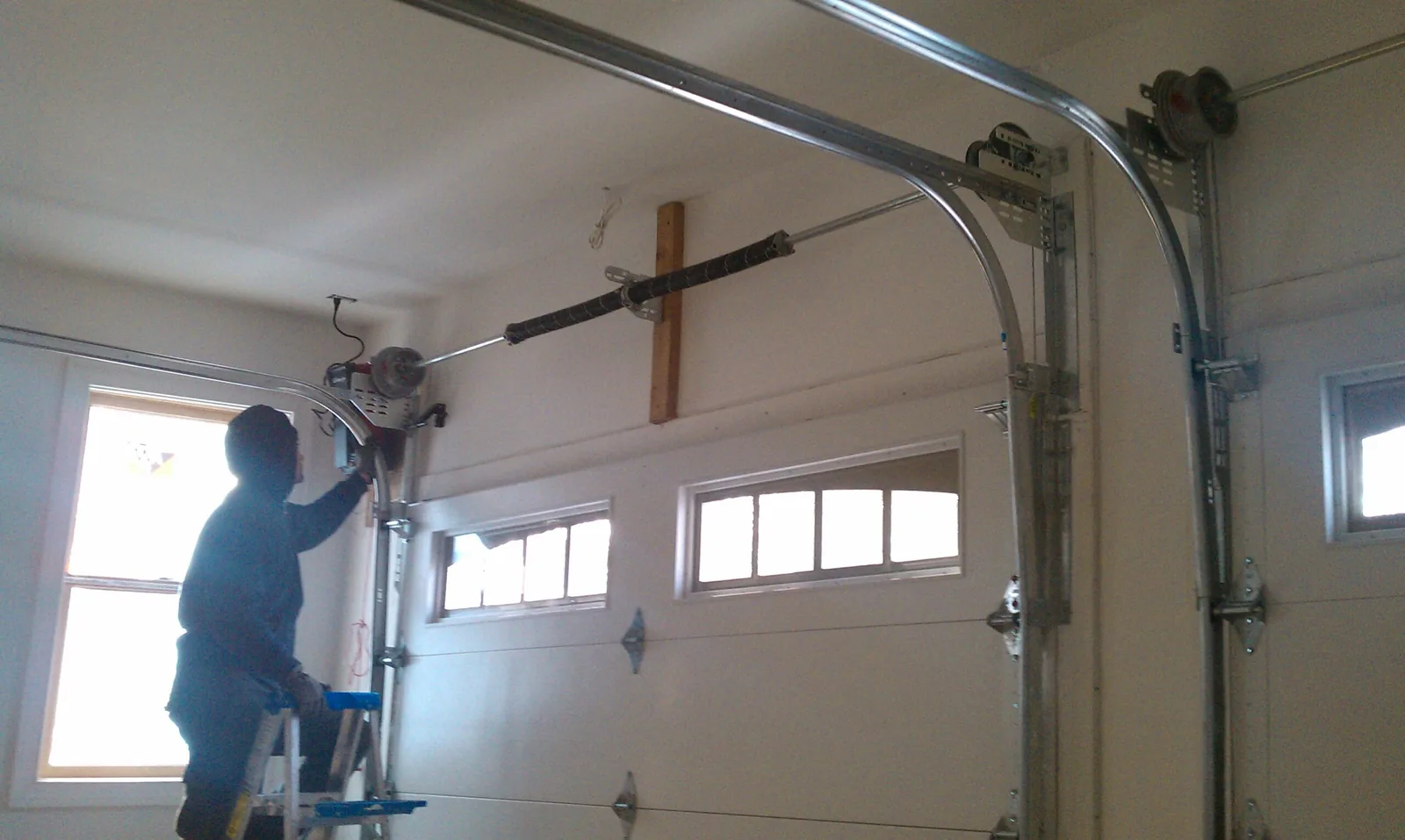
Look at the spring above the door for a visible gap or separation, and check that the lift cables on each side are intact and seated. If you see a broken spring, a frayed cable, or a door off its track, do not operate the door. Stop here and call.
A broken spring, frayed cable, or off-track door is not a DIY job.
These parts store enough tension to cause serious injury, so keep the door closed, keep everyone clear, and let a trained tech handle it.
The Loud Ones: Grinding, Banging, and a Door Off Its Track
Noise is one of the most useful symptoms because the sound itself narrows the cause. A high squeak or chirp on every cycle is usually dry rollers and hinges that just need lubrication. A heavy grinding from the opener head often means a stripped drive gear inside the unit. A sharp bang — especially one loud crack — frequently signals a spring that has just let go. And a steady metal-on-metal scrape can mean rollers are wearing out or the door is starting to bind in the track.
When a door comes off track, it's both the most obvious problem and one of the most dangerous. The rollers have jumped the rails, the door hangs crooked, and the whole system is out of balance. This commonly follows a vehicle bump, a snapped cable, or rollers that finally gave out. Do not try to force it back or run the opener — a door in this state can fall. Leave the door alone and call right away if you see a broken or separated spring, a frayed or snapped cable, a door off its track or hanging crooked, a stuck door that feels heavy by hand, grinding from the opener, or a door that slams shut instead of lowering under control. An A&E tech will secure it, reset it on the track, and check the springs, cables, and rollers that allowed it to happen.
Slow, Jerky, Remote Trouble — and When to Call A&E
Not every problem is a crisis. A door that moves slow or jerky is often telling you the rollers are worn, the tracks need cleaning and lubrication, or the springs are starting to lose their balance. Caught early, these are straightforward maintenance fixes that keep a small annoyance from becoming a broken-down door at the worst possible time.
When the remote won't work, start simple: fresh batteries, then test the wall button. If the wall button operates the door but the remote doesn't, the remote likely needs reprogramming or replacing. If nothing responds, the opener itself may have lost power or its logic board may be failing. We service and repair all major garage door and opener brands, so whatever name is on your unit, we can diagnose it.
Whether your door won't open, won't close, makes a racket, or has jumped its track, the smartest move is a fast, honest diagnosis before a small issue turns into a stuck car and a missed morning. A&E Emergency Garage Door Repair is open 24/7, licensed and insured, and serves homeowners across the Kansas City metro on both the Kansas and Missouri sides. Call (913) 404-5111 for a quick diagnosis and a clear plan to get your door working again.
Stuck on one specific symptom? Our deep-dive on why a garage door won't close all the way walks through the seven most common causes and the quick checks you can try before you call.
Good to know
Frequently asked questions
My garage door won't open — what's wrong?
Why does my garage door reverse before closing?
Is it safe to fix a garage door spring myself?
Related services & guides
Garage Door Repair
Broken spring, door off its tracks, opener that won't respond? We repair every make and model, usually same day.
Learn moreSpring Repair
A loud bang and a door that won't lift usually means a broken spring. We replace torsion and extension springs safely.
Learn moreOff-Track, Cables & Rollers
Door off its tracks, hanging crooked, or grinding? We realign tracks and replace cables, rollers, and drums.
Learn more